Full research and the plugin → github.com/bcanfield/agentic-tech-debt
The Firebase database behind Tea was sitting open on the internet last July, and anyone who found the URL could read all of it. Roughly 72,000 images. Around 13,000 of them government IDs: driver's licenses and selfies people had uploaded to prove they were women, because Tea is a women-only app for vetting men before a date. Past that, 1.1 million-plus private messages. No password, no auth check, no token. Just a bucket you could point a script at.
The IDs existed because the app asked for proof of identity to keep men out. Then it stored that proof somewhere a man on 4chan could grab the lot in an afternoon. The thing built to protect the users is the thing that doxxed them.
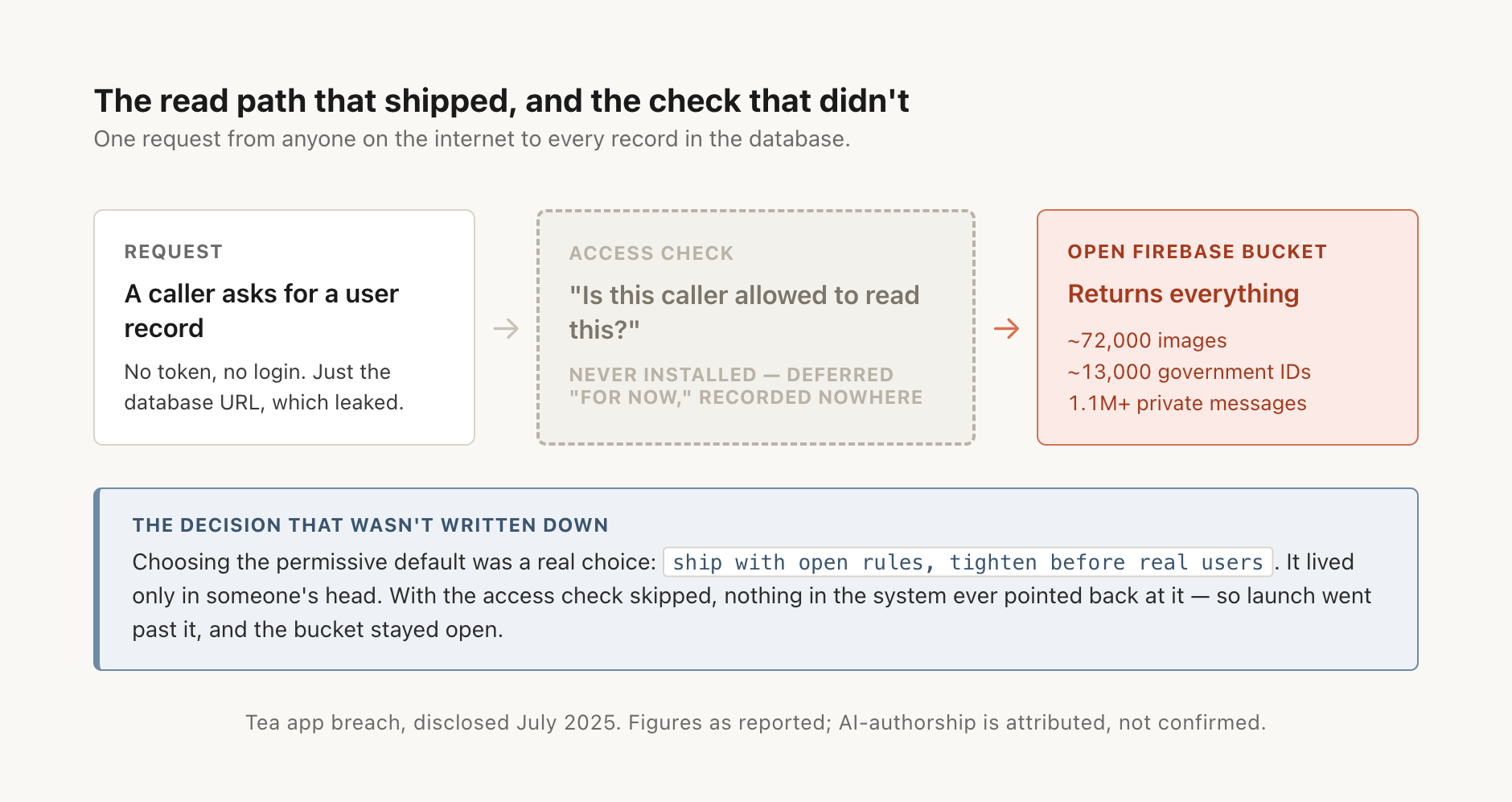
One caveat before the rest. The widely-repeated attribution (that this was "vibe coding," AI-generated code shipped without a security review) comes from the original 4chan poster and got picked up across the coverage. I haven't seen Tea confirm how the code was written, so don't take "an AI did it" as established. What is established is the shape of the failure, and that shape doesn't need an AI to explain it. An open database with no access control is one of the oldest mistakes there is. AI just makes it faster and quieter to commit.
So set the attribution aside and look at the mechanism. A Firebase database has rules, the layer that says who can read what. Spin a Firestore database up in test mode and it writes you the most permissive rule there is, with a banner warning that it expires in 30 days:
// Firestore test mode: the default a new database ships with
allow read, write: if true;
It's permissive on purpose, so you can build without fighting the auth layer first, and tightening it is a separate step you take before you ship. Somewhere between "let's get this working" and "this is live with real users' driver's licenses in it," that step didn't happen. I want to be precise about what kind of failure that is, because "they forgot to secure the database" makes it sound like a slip. Locking it down is real work: you write the rules, test that an unauthenticated request actually bounces, confirm one logged-in user can't read another user's record. Call it an afternoon. Under deadline, with the app already working in the demo, that afternoon is the easiest thing in the world to push to "before launch," then to "right after launch," then off the edge of anyone's memory. So I don't read the open database as an accident. I read it as a decision, we'll lock it down later, made by default and never revisited because nothing pointed back at it.
I've made the smaller version of that call. Spin up a dev backend with the rules wide open so you can iterate, tell yourself you'll tighten them before anyone real touches it, and the only record of "open on purpose, fix later" is a thought you had on a Tuesday. I tightened mine in time, but that wasn't discipline. It's the same lapse Tea had, except I never had 13,000 driver's licenses sitting behind the open rule.
That's the through-line under these stories, and Tea is the cleanest case of it. The damage doesn't trace to a line of bad code. It traces to a deferral nobody recorded. Nobody wrote "shipping with open Firebase rules, must fix before we have real IDs in here" anywhere a person would later trip over it. If they had, the breach is a five-minute conversation in a standup three days before launch instead of 13,000 leaked IDs.
Guillermo Rauch, who runs Vercel, made the joke that wrote itself:
"On Tea Dating, AI and Vibe Coding security TL;DR: the antidote for mistakes AIs make is... more AI."
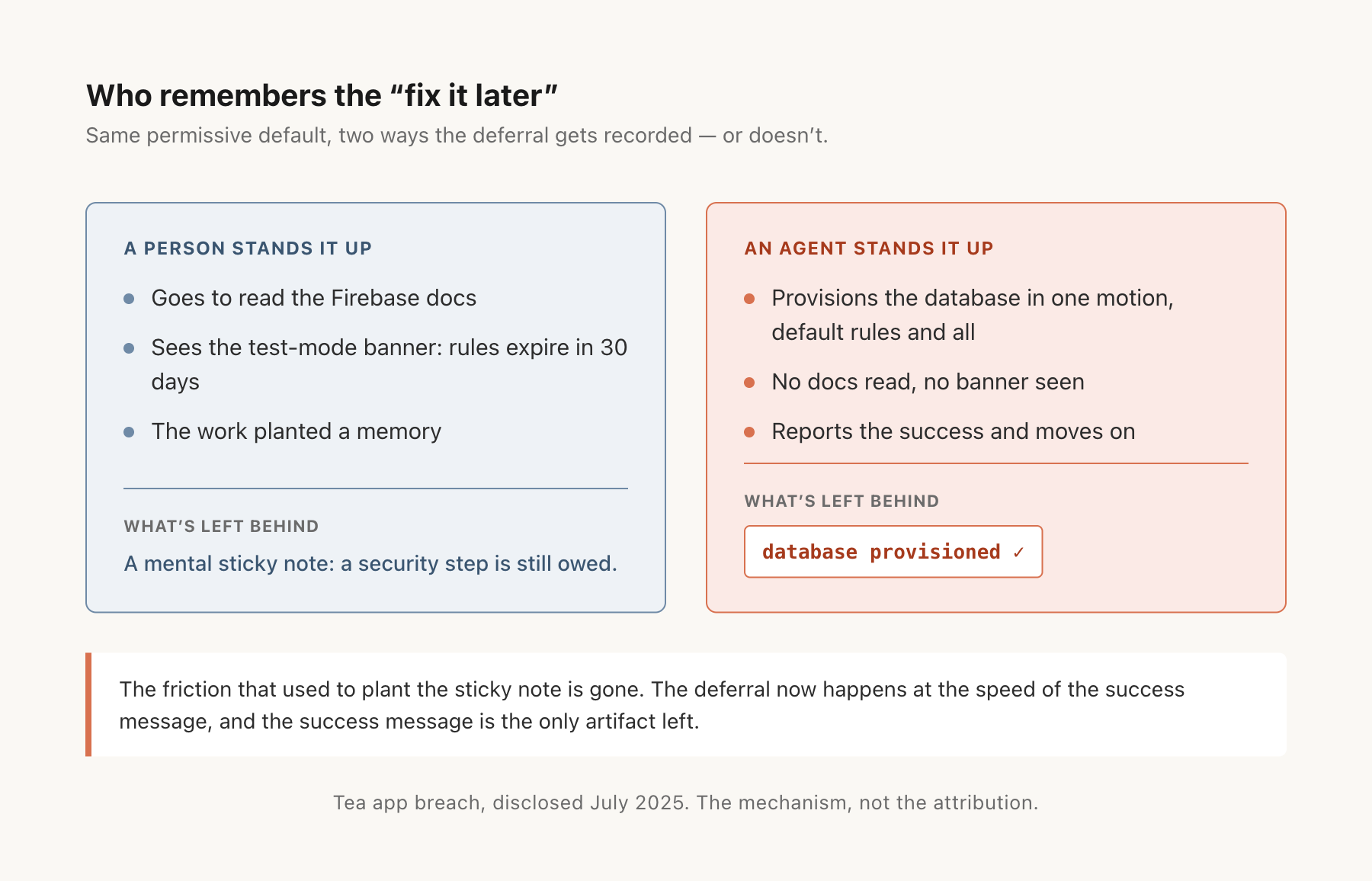
That's the reflex: ship faster with the tool, then bolt on a second tool to catch what the first missed. But a better code generator still doesn't surface the decision it just made on your behalf. AI does change one thing here, and it's narrower than the headlines claim. When a human stands up that database, friction works in their favor. They had to go read the Firebase docs. They saw the warning about test-mode rules. The act planted a memory that a security step was still owed. An agent stands up the same database in one motion, default rules and all, tells you it's provisioned, and moves on. The friction that used to leave a mental sticky note is gone. The deferral now happens at the same speed as the success message, and the success message is the only artifact left behind.
So the cheapest control that would have caught Tea isn't a scanner or a pen test or another model reviewing the first one's output. It's a note. A line, written the moment someone chose the permissive default, that says: this is open on purpose for now, here's the condition that ends that (real user data lands in it), here's where it lives. One sentence checked into the repo, where the next person, or the same person a month later, would trip over it the night before launch. Tea never had that sentence anywhere, which is why the rule stayed open into production.
That's what I've been building toward with debt-ops. It hooks a coding agent and writes each deferred decision to a markdown file the agent's "database provisioned" summary never mentions, so a choice like leaving auth off for now lands somewhere a person can find it before launch. The repo is github.com/bcanfield/agentic-tech-debt. To be clear about its limits: it doesn't write secure rules, and it can't tell a permissive default from a deliberate one. All it does is turn the silent choice into a line of text you have to read and dismiss on purpose rather than never see at all.
Cover photo by Michael Chacon on Unsplash.